Methods of Teaching:
Engaging Students, Building upon Prior Knowledge, and Employing a Variety of Teaching Techniques
Outlined below are some of the different methods and materials that I use in my teaching.
Matching and Grouping Activities: Engaging students, activiating prior knowledge, and encouraging compare/contrast analysis
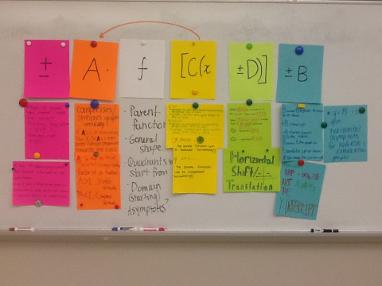
For example, I always start the year in Calculus doing a "Function Matching" activity where the students have to match the graph of a function to its equation, domain, and range. I use functions from all different "families" (polynomial, rational, trigonometric, exponential, logarithmic, absolute value, piecewise), as well as different compositions of functions, to see what they remember about the key characteristics of each family as well as the effects of different transformations and compositions.
Another example is when teaching about the different forms of quadratic functions. I give each student the graph of a certain parabola and, as a class, they have to divide themselves into three groups. With directed questioning, I help them to form groups based on the location of the parabolas in the coordinate plane. This starts our comparison of graphs of the forms ax^2+c, ax^2+bx, and ax^2+bx+c, and leads nicely into solving such equations.
"Link Sheets": Helping students to make connections
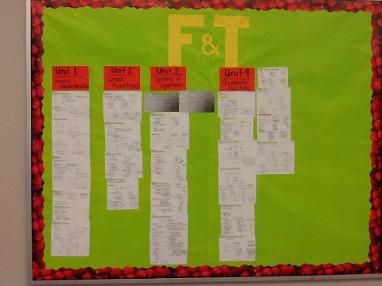
I use "link sheets" regularly to reinforce the concept of multiple representations of functions (table, graph, equation, and verbal description) and to help students make connections between these representations.
I also "link sheets" to help students make connections between different forms of equations.
"Levels": Helping students to compare and contrast, and to gauge their own progress
I use "Levels" of problems for a variety of topics. These are sets of problems ordered by level of difficulty which the students complete at their own pace. These problem sets are useful because the student can clearly identify, for example, "I can do levels 1 and 2 but not level 3." This leads to productive discussions about how the problems at one level compare to those at a different level, and how the students can recognize and solve these problems in the future.
Toolkit cards: Helping students to organize and retain information
Students create a mathematical "toolkit" which consists of index cards with key ideas, definitions, procedures, and examples. Ideally, they build upon this toolkit throughout their mathematical career, and use it as their own personal "quick reference guide." Students on IEPs often use the toolkits on quizzes and tests as part of their accommodations.
Group Work & Presentation: Encouraging collaboration and productive discussion
Students consistently work collaboratively to solve problems, both as reinforcement and investigation. Often, they work in groups to investigate different topics by
studying a wide variety of examples (such as horizontal transformations
of functions or characteristics of rational functions) and then share
their findings with the class so we can come to some general conclusions. Sometimes, I present a problem that they don't really know how to solve yet so that I can see what they come up with (for example, when introducing the idea of finding area under a curve or finding a polynomial equation using the method of undetermined coefficients).
Cumulative Review Activities: Engaging reinforcement and repetition
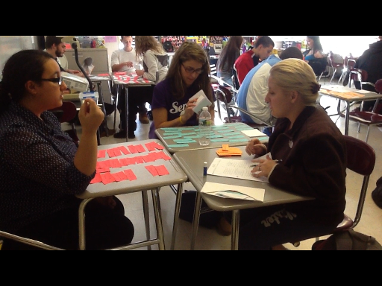
To keep the students engaged when reviewing material, I sometimes use "fun" activities, such as Bingo, puzzles, and "Jeopardy"-style trivia games.

|
F&T Link Sheets All Methods of Systems.doc Size : 168.5 Kb Type : doc |
|
|
Quadratic Forms Link Sheet copy.doc Size : 66.5 Kb Type : doc |

|
4 Integral Levels.xls Size : 346 Kb Type : xls |
|
|
F&T Solving QuadEqs LEVELS.doc Size : 70.5 Kb Type : doc |